RESEARCH / SELECTED WORK

Perception,
in practice.

Three studies exploring multimodal fusion: its architectures, robustness and inference cost.

INTERACTIVE DIAGRAM · EDUCATIONAL ILLUSTRATION

One world.
More than one way to see it.

Explore what each sensor contributes to understanding a scene.

Illustration of a street with a vehicle and a pedestrianSynthetic scene: annotations are hand-drawn, with no model inference or performance measurement. The blend illustrates complementary signals and does not reproduce MEFA.PedestrianVehicle

Fusion: RGB colors and infrared contrast are overlaid here. Adjust the blend to explore their contributions.

Synthetic scene: annotations are hand-drawn, with no model inference or performance measurement. The blend illustrates complementary signals and does not reproduce MEFA.

VISAPP 2025 / 2025

MEFA

Fuse first. Detect next.

My role
First author

InputsRGB + IR + LiDAR
FusionAttention
DetectionYOLO / RT-DETR

The problem

In rain or fog, a single sensor may not provide a sufficient representation of the scene.

The approach

An attention-based early-fusion module combines RGB, infrared and LiDAR before an object detector. The study compares this approach with channel concatenation.

What the study shows

The work studies pedestrian and vehicle detection with YOLOv8 and RT-DETR in adverse weather. Fusion is placed upstream of single-modality detectors.

Published qualitative results — MEFA
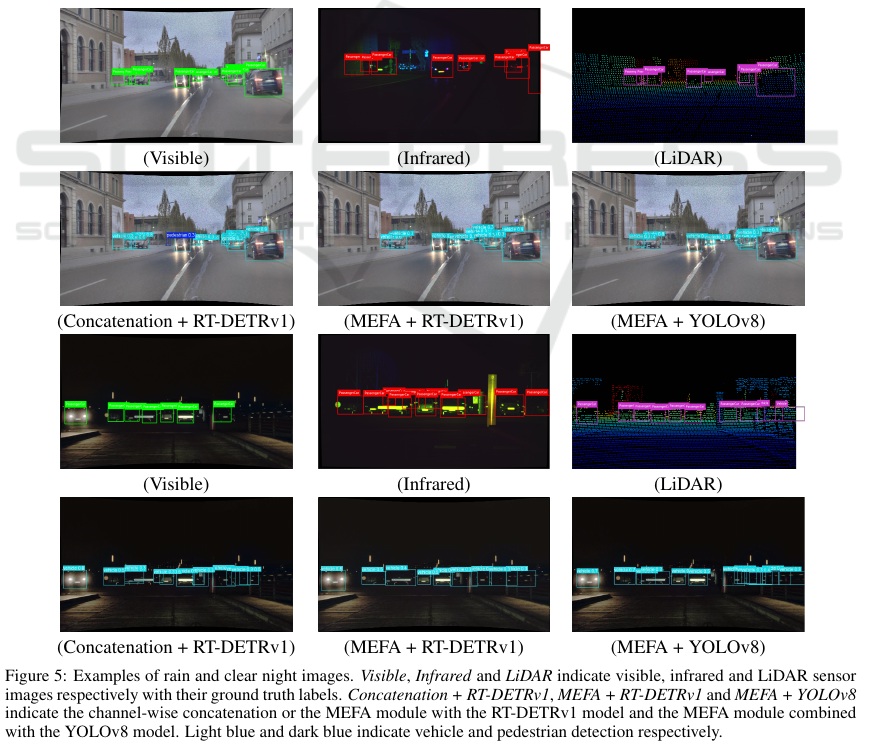
Rain and night comparisons: visible, infrared, LiDAR, followed by detections with concatenation or MEFA. Figure 5 from the original paper; interpret it within its experimental setup.

Rain and night comparisons: visible, infrared, LiDAR, followed by detections with concatenation or MEFA. Figure 5 from the original paper; interpret it within its experimental setup.

Dupas, Hotel, Lefebvre & Cérin · VISAPP 2025 · Source: Figure 5, p. 616 ↗ · CC BY-NC-ND 4.0 ↗

Source publication : MEFA: Multimodal Image Early Fusion with Attention Module for Pedestrian and Vehicle Detection

Full text (PDF) ↗DOI ↗Read paper ↗

ICMV 2025 · SPIE / 2026

MEFA-MS

Make fusion more efficient.

My role
First author

InputsMultimodal
FusionU-Net + Attention
DetectionRT-DETR

The problem

MEFA’s inference time can limit real-world use. The trade-off between detection quality and model cost needs attention.

The approach

MEFA-MS introduces a U-Net encoder-decoder with spatial and channel attention, compared with MEFA on DENSE.

What the study shows

With RT-DETR on DENSE, the authors report 50% lower inference time than MEFA alongside improved mAP50. These findings apply to the paper’s experimental setup.

Source publication : MEFA-MS: attention-based U-Net for pedestrian and vehicle detection

Full text (PDF) ↗DOI ↗Read paper ↗

ICCV Workshops 2025 · MIRA / 2025

FMCAF

Explore how fusion generalizes.

My role
Coauthor

InputsRGB + IR
FusionFreq-Filter + Cross Attention
DetectionDetection

The problem

A fusion strategy suited to one setting does not necessarily transfer to different scenes or datasets.

The approach

FMCAF combines frequency filtering with cross-attention fusion to reduce redundant information and improve RGB–infrared feature sharing.

What the study shows

The architecture is evaluated on LLVIP for low-light pedestrians and VEDAI for aerial vehicles. These evaluations explore robustness in two different settings, without establishing universal generalization.

Source publication : Towards a Generalizable Fusion Architecture for Multimodal Object Detection

Full text (PDF) ↗DOI ↗Read paper ↗

LET’S CONNECT

An idea worth
exploring together?

For scientific and technical discussions about computer vision and multimodal perception.

Send me an email

BibTeX citation